
%20(1).jpg)
.webp)
.webp)
[ 01 ]
Wind Power Collection
.webp)
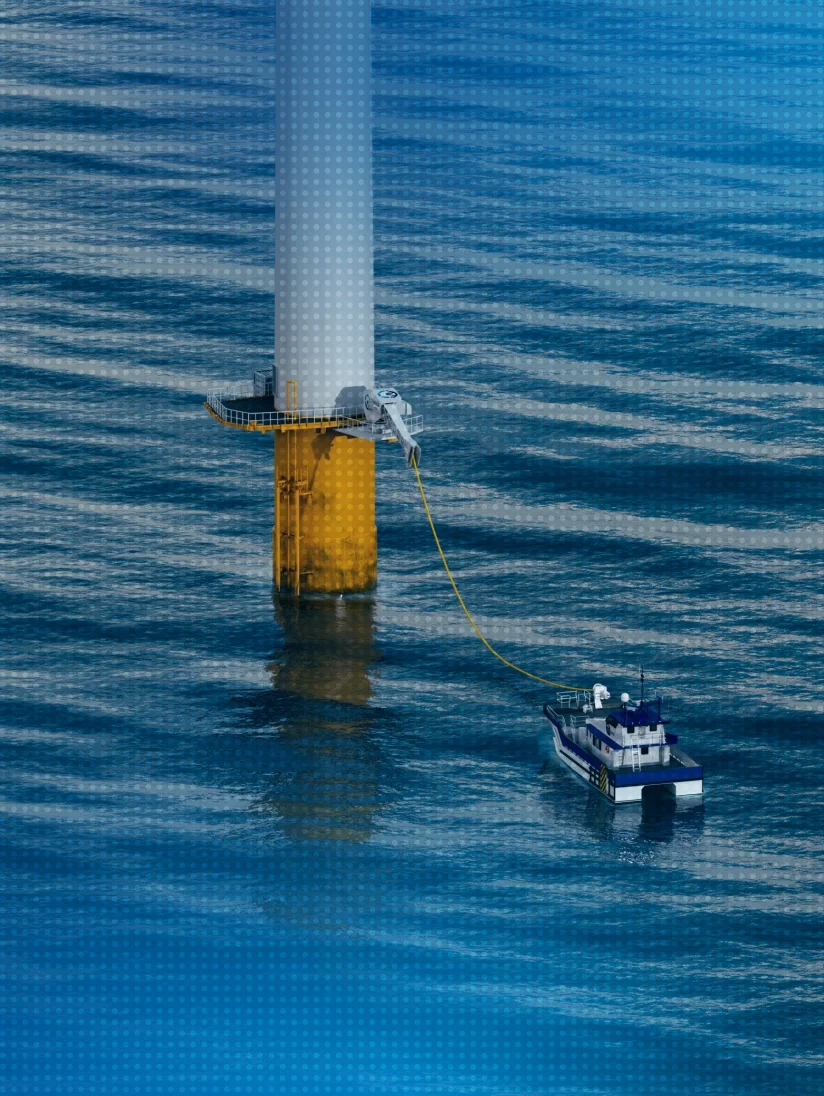
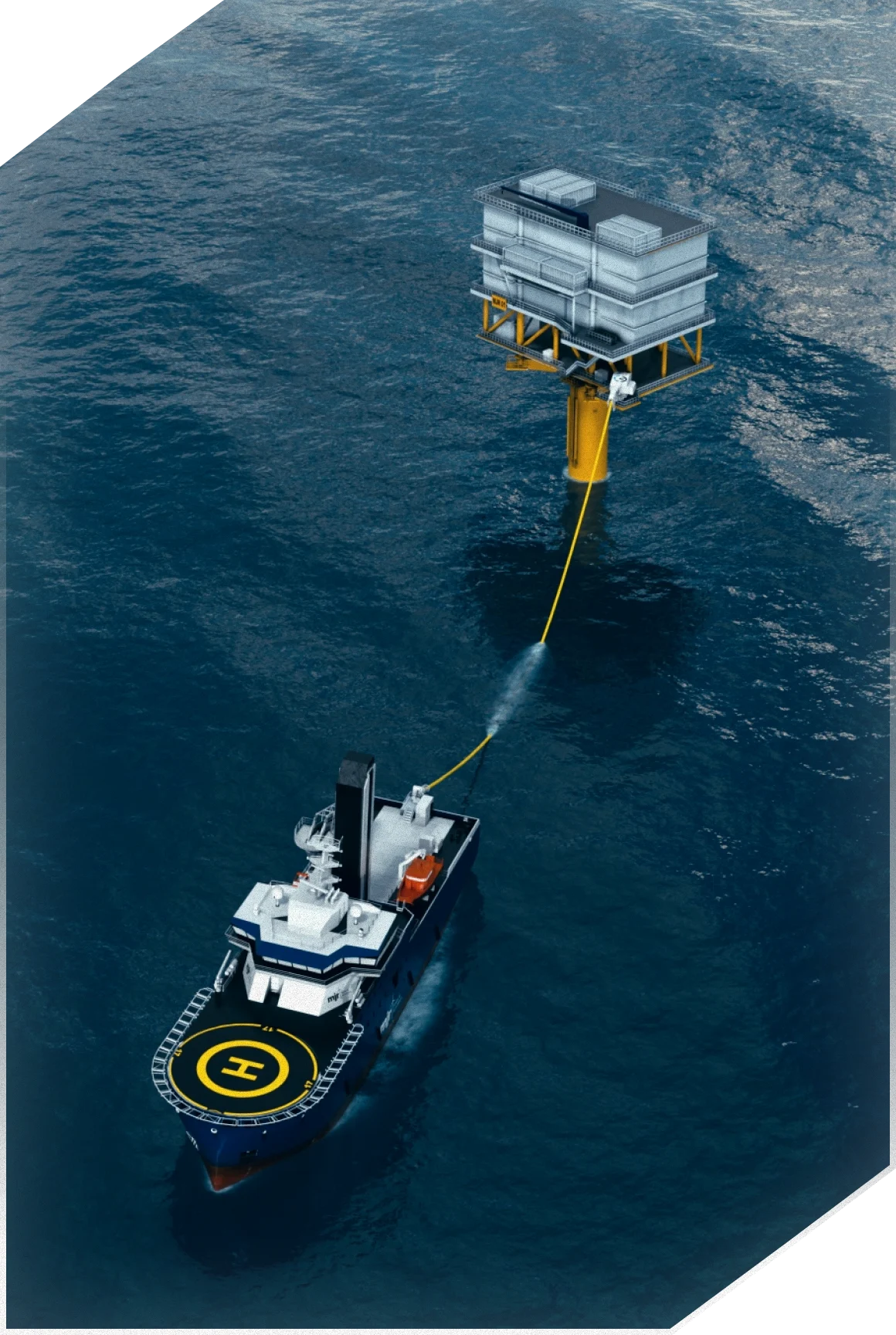
High voltage charge power taken directly from the production site through a connection to the inter-array network. Tapping is possible from either a turbine or a sub-station
33 / 66 / 132 kV
Direct array tapping
Continuous
power availability
100%
renewable energy
[ 02 ]
Vessel Approach
.webp)
Vessel requests access to MCC and positions downwind at safe distance of the charging Asset, ready for connection. Connection is possible in sea states higher than limits for personnel and cargo transfers
DP/Push-on
System Compatible
High Sea
State Access
24/7
All-Weather Ops
[ 03 ]
Automated Deployment
.webp)
A fully remote, highly automated connection process is executed without personnel on deck at any stage, minimizing human error and risk.
< 2 Minutes
Connection Time
Zero
Manual Intervention
Secure
Mechanical Lock
[ 04 ]
Economical Charging
.webp)
While charging, the vessel maintains a low consumption position keeping with charger optimising catenary shape in real time: Maximum power is transfered to the battery packs, minimising charge time. Patent Pending. Covered by U.S. Patent Publication No. US 2026/0158945
0.5 – 8 MW
Power Range
93%
Transfer Efficiency
Variable
Voltage Output
[ 05 ]
Active Safety Monitoring
.webp)
During the whole charging cycle, both vessel and onshore control centre have live access to all charge system parameters and alarms. Redundant in-built safety features guarantee mechanical and electrical integrity of both vessel and offshore asset in case of failure detection. Patent Pending. Covered by U.S. Patent Publication No. US-2025-0236192
Real-Time
Data Analytics
Active
Tension Control
Motion
Compensated
[ 06 ]
Rapid Recovery
.webp)
In case of emergency, the Master can instantly shut down the charge power and release the vessel. The process is also automatically activated in case of automatic overload detection. The connector is automatically retracted to safe storage position and is ready for next charge cycle without any maintenance requirements
Instant
Emergency Release
Auto
Retraction Cycle
Ready
For Next Vessel
[ System Capabilities ]
A fully automated compact system designed for rapid charge cycle and reliability
Economical Operation
Engineered for cost-effective performance, our system significantly reduces operational expenses (OPEX). By combining robust, low maintenance components with a smart design, we ensure reliable power transfer that minimizes costly downtime and service intervals.
.webp)
High sea state workability
Large operational window: Vessel connection and charging possible in sea states higher than personnel and cargo transfer limits
.webp)
Compact Footprint
Compact and modular charging equipment for rapid and economical mobilisation and hook up on any fixed or floating offshore infrastructure; Typically TP, OSS, dedicated monopile or jacket, mothership, floating support etc..
.webp)
Hands-Free Operation
Fully remote controled and highly automated charging process. No personnel required on deck at any time, from connection to charge cycle and disonnection.
.webp)
Safety Focused
Inbuilt redundant active and passive safety features guaranty integrity of vessel and asset in normal, degraded and black out modes.
.webp)
Low Maintenance
System is built with marine grade components proven for reliability in offshore environment. Equipment is designed for ergonomic and safe access to any parts that require maintenance or replacement.
.webp)
Operational Security
Charger weathervaning function ensures the vessel can connect and charge while remaining in safe "drift away" position of the asset at all times.
.webp)
Fully Automated Cycle
Inbuilt control system ensures Master/Operator can manage all charging operations from the bridge console and Onshore Marine Control Centre maintains live visibility on all charger parameters, warnings and alarms, including power transfered for billing purpose.
.webp)
Instant Emergency Release
Redundant active and passive ejection systems allow vessel to be freed from asset in less than 3 seconds in case of any emergency or overloading.
01
02
03
04
05
06
07
08
09
/ 09
[ FAQ ]
Clear answers on our Safety-Focused technology
Why is offshore charging considered essential for wind O&M fleets?
Can offshore charging enable CTVs and SOVs to operate entirely electrically at wind farms?
Where is the charger installed, and how many are needed on site?
How safe are offshore charging operations for personnel, assets, and vessels?
Can a single charger unit service both CTVs and SOVs?
[ Get in Touch ]
Discuss newbuild or retrofit charging solutions with the Charge Offshore team.
Thank you! Your submission has been received!
Oops! Something went wrong while submitting the form.